
Five Thai men attended a peaceful, pro-democracy protest in October 2020 that briefly delayed the Thai Queen’s motorcade. The men were not aware of the motorcade and moved away from the road as soon as they realized a royal motorcade was passing. Following the protest, Aekachai Hongkangwan, “Francis” Boonkueanun Paothong, “Tan” Suranat Panprasert, Mr. “Keng” (name withheld), and Mr. “Kwan” (name withheld) were charged under Thai Criminal Code Section 110 for attempting to commit an act of violence against the Queen’s liberty, a rarely-used criminal provision with a mandatory minimum sentence of 16 years in prison. After being acquitted by the trial court, they were convicted on appeal. Four of the men were sentenced to 16 years in prison, and Mr. Hongkangwan was sentenced to 21 years and four months. They are currently detained and have been denied bail as they appeal their convictions to Thailand’s Supreme Court. This case marks the first application of Section 110 to criminalize acts of peaceful assembly and expression during the 2020–2021 pro-democracy movement.
On October 14, 2020, prominent activist Aekachai Hongkangwan, “Francis” Boonkueanun Paothong, “Tan” Suranat Panprasert, Mr. Keng, and Mr. Kwan attended the pro-democracy #October14Protest in Bangkok, organized by the “People’s Movement 63.” The protest included calls for reforms to the government and monarchy. The five men, who did not know each other beforehand, were among a smaller number of people who arrived at the end destination of the protest march, the Government House, ahead of the main group. Unbeknownst to those present, including these five men, the protest near the Government House coincided with a royal motorcade carrying the Queen. The route of the motorcade was not publicly disclosed in advance, and the five men were unaware it would pass through the protest area.
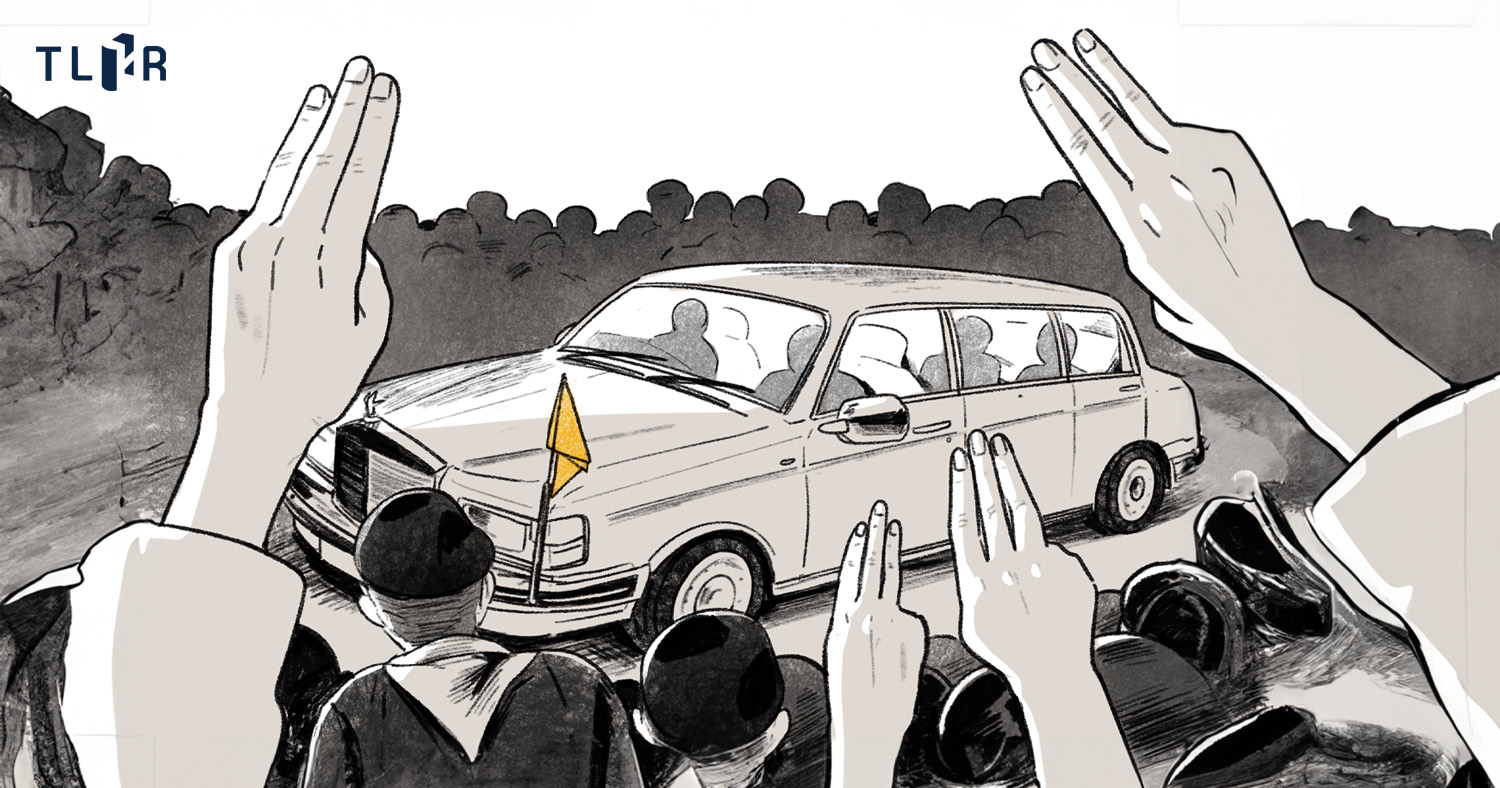
The motorcade passed through the area in approximately six minutes, experiencing only a brief delay. As the motorcade first approached the protest area, the police formed multiple lines of officers and opened one lane in a barricade across the road formed by police vans. The police effectively blocked any view the five men may have had of the motorcade. The police advanced toward protesters and physically pushed people back on the road, but did not make any announcement that the royal motorcade was approaching. Believing that the officers intended to disperse the peaceful protest, some protesters briefly sought to block the dispersal—including Mr. Hongkangwan, Mr. Paothong, and Mr. Kwan—but were quickly pushed back by lines of officers. Mr. Panpasert shouted “Sit down! Sit down!” since he thought it would deescalate the situation and prevent injuries, but those who briefly sat down stood up again as the police pushed other protesters into them. Mr. Keng, who had attended as an observer and artist, took photographs of the crowd and passing cars but did not know the cars were transporting members of the royal family.
Once the men realized a royal motorcade was passing, they moved away from the road. Members of the crowd raised a three-finger salute, a pro-democracy gesture, as the motorcade was passing, including Mr. Hongkangwan, Mr. Kwan, and Mr. Keng.
Following the protest, the five men were charged under Section 110 of the Thai Criminal Code for attempting an act of violence against the liberty of the Queen, along with additional charges under Sections 215 (unlawful assembly causing a breach of the peace) and 385 (road obstruction affecting safety or traffic) and Sections 114 and 148 of the Land Traffic Act (unauthorized traffic obstruction and related offenses). Mr. Hongkangwan and Mr. Paothong were arrested on October 16, 2020, and Mr. Panprasert was arrested on October 21, 2020. These three men were briefly held in pre-trial detention in 2020, while Mr. Keng and Mr. Kwan were not detained pre-trial.
On June 28, 2023, the Ratchada Criminal Court—the court of first instance—acquitted the five men of all charges, finding that they lacked intent to obstruct the royal motorcade and had misunderstood the situation, believing the police were attempting to disperse the protest. The prosecution appealed. On September 5, 2025, the Court of Appeal overturned the acquittal, convicted all five men, and imposed lengthy prison sentences. Four men were sentenced to 16 years’ imprisonment, and Mr. Hongkangwan was sentenced to 21 years and four months.Following the appellate judgment, the five men were immediately detained on September 5, 2025. They were held at Bangkok Remand Prison until September 12, 2025, when they were transferred to Klong Prem Central Prison. Their requests for bail pending their appeal to the Supreme Court have all been denied. The men filed an appeal to Thailand’s Supreme Court in December 2025, which remains pending.
The case of Mr. Hongkangwan, Mr. Paothong, Mr. Panprasert, Mr. Keng, and Mr. Kwan arises in the context of Thailand’s broader repression of dissent and peaceful political activism. Human rights defenders, pro-democracy activists, academics, journalists, and artists in Thailand have faced ongoing surveillance, harassment, and criminal prosecution for activities perceived as critical of the government or the monarchy within a restricted civic space.
Widespread youth-led protests took place across Thailand in 2020–2021, calling for democratic reform, including reform of the monarchy. In November 2020, then-Prime Minister General Prayut Chan-o-cha publicly stated that “all laws” would be enforced against protesters, signaling an intensified crackdown on dissent. Authorities relied on a range of criminal provisions to pursue demonstrators, including lèse-majesté (Section 112), sedition (Section 116), and public order-related offenses.
Thailand’s lèse-majesté law under Section 112, which criminalizes defamation, insults, or threats against the monarchy and carries severe prison sentences, has been widely used since late 2020. The UN has repeatedly expressed concern regarding Thailand’s use of the lèse-majesté law, emphasizing that criminal penalties for peaceful criticism of public institutions, including the monarchy, are incompatible with international human rights standards. Civil society organizations have similarly documented the revival and expansion of such prosecutions in the wake of the 2020 protests.Section 110 of the Thai Criminal Code, which criminalizes acts of violence against the Queen or her liberty, carries severe penalties with a sentence ranging from 16 years to life imprisonment. The provision has rarely been used, and the present case marks its first application in response to the 2020–2021 pro-democracy movement. Section 110’s use alongside more commonly invoked public order and traffic-related laws reflects a broader pattern of employing serious criminal charges to punish and deter peaceful protest activity and dissent.
- Thai Lawyers for Human Rights, บันทึกทนายความ: สรุป 11 ข้อเท็จจริงในคดีมาตรา 110 หลังศาลยกฟ้อง [Lawyer’s Notes: Summary of 11 Facts in the Section 110 Case After the Court Dismissed the Case.] (5 July 2023)
- Thai Lawyers for Human Rights, ศาลอุทธรณ์กลับคำพิพากษา คดี ม.110 เชื่อว่า 5 จำเลย พยายามขัดขวาง “ขบวนเสด็จ” ลงโทษจำคุกคนละ 16 ปี ส่วน “เอกชัย” เพิ่มโทษรวม 21 ปี 4 เดือน รอลุ้นประกันชั้นฎีกา [The Court of Appeal overturned the verdict in the Section 110 case, finding that the five defendants attempted to obstruct the royal procession and sentencing them to 16 years in prison each. Aekachai’s sentence was increased to a total of 21 years and 4 months. He awaits the Supreme Court’s decision on bail.] (5 September 2025)
- CIVICUS, Thailand: Drop charges against peaceful protesters and end restrictions on civic freedoms (19 October 2020)
- UN Working Group on Arbitrary Detention Petition Filed by Thai Lawyers for Human Rights, the Robert & Ethel Kennedy Human Rights Center and Columbia Law School’s Human Rights Institute